Annual Reports
eToro Group Ltd.'s annual reports contain management's most considered account of the business. These are the sections, passages and visual pages worth opening in the originals preserved in Sources.
eToro Group Ltd. — FY2025 Annual Report (Form 20-F) — FY2025
eToro's first annual report as a public company (Nasdaq IPO May 2025) — the founder-led social-investing brokerage explaining its multi-asset, crypto-heavy model in full. · Open the full document →
Item 3. Key Information — Risks: CopyTrader, Smart Portfolios and Finfluencers — p. 37 · Read the full section →
eToro's signature social features carry its most distinctive regulatory exposure — U.S. CopyTrader is limited pending FINRA approval.
Copy-trading's regulatory treatment is inconsistent across jurisdictions; U.S. rollout hinges on FINRA.
Our social features, specifically CopyTrader and Smart Portfolios, which allow users to follow and replicate the trading activities of other users or portfolios, respectively, may expose us to certain operational, regulatory and reputational risks. […] In the U.S., CopyTrader is currently only available on a limited basis and we may be required to suspend our offering of CopyTrader if FINRA does not approve a Continuing Membership Application we have filed in connection with the continued launch and operation of the CopyTrader service.
p. 37 · Read in context →
Item 3. Key Information — Risks Related to Cryptoassets and Cryptoasset Markets — p. 44 · Read the full section →
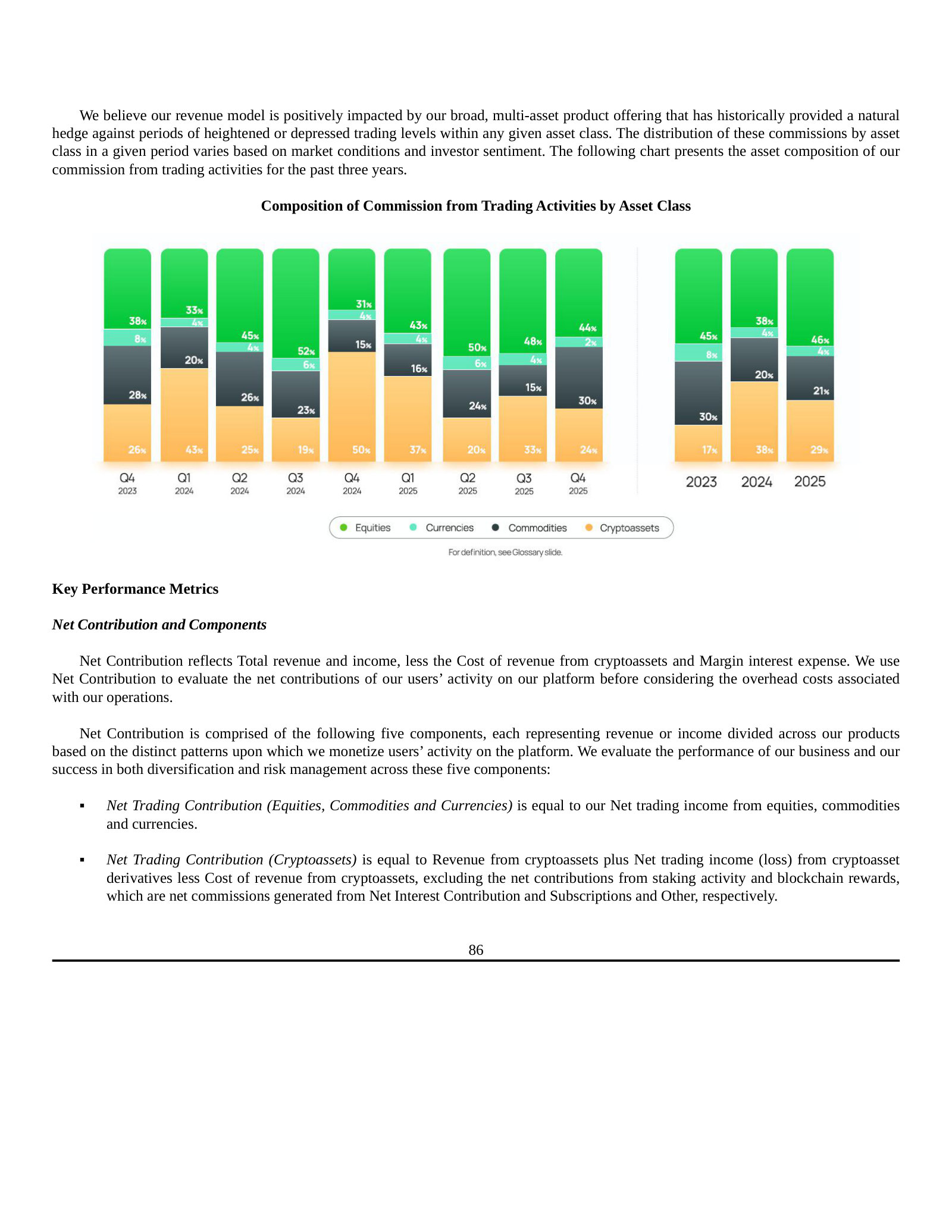
Crypto was 17%–38% of trading commission; results ride bitcoin's price and volume, and a 'security' ruling could force delistings.
eToro's own risk-based test — not a legal standard — decides which cryptoassets it treats as non-securities.
We currently facilitate customer trades for certain cryptoassets that we have analyzed under applicable internal policies and procedures and, for cryptoassets supported on our platform, that we believe are not “securities” under the applicable laws in a relevant jurisdiction. Although we maintain a strict policy and we perform ongoing monitoring and legal review, our policies and procedures do not constitute a legal standard, but rather represent our company-developed risk-based assessment regarding the likelihood that a particular cryptoasse could be deemed a “security” under applicable laws. In the event that we determine that a supported cryptoasset could be deemed a security or that the continued support of a cryptoasset presents a risk to us or our users, we aim to take prompt action to discontinue the trading and custody of the cryptoasset. Users that traded a supported cryptoasset on our platform and suffered trading losses could also seek to rescind a trade on our platform on the basis that eToro effected their transactions in violation of applicable law, which could subject us to significant liability.
p. 47 · Read in context →
Item 3. Key Information — Risks Related to Our Operations in Israel — p. 67 · Read the full section →
HQ, founders and much of management sit in Bnei Brak, Israel — concentrating the business in a region prone to armed conflict.
Founders, management and HQ are Israel-based; regional instability could disrupt operations.
Many of our employees, including our founders and certain members of our management team, operate from our headquarters that are located in Bnei Brak, Israel. In addition, a number of our officers and directors are residents of Israel. […] Israel has experienced, and may in the future experience, armed conflicts, terrorist activity, civil unrest, and political instability, which could disrupt our operations and supply chain.
p. 67 · Read in context →
Item 4. Information on the Company — Business Overview — p. 82 · Read the full section →
Management's own account of the social-investing model, the CopyTrader flywheel and the breadth of the multi-asset platform.
Product breadth: 150+ cryptoassets, 127 Smart Portfolios, and 4,750+ copyable Pro Investors.
We provide our users with a gateway to the global financial markets, offering a platform that empowers our users to invest, trade, save and spend in a way that suits their unique needs. On our platform, users can trade equities, commodities, currencies and cryptoassets, traded as the underlying asset or a derivative, depending on the asset class and on the user’s location. On our global platform, users can trade thousands of instruments, including over 150 cryptoassets, 127 curated Smart Portfolios, and copy over 4,750 members of the Pro Investor program.
p. 88 · Read in context →
Item 5. Operating and Financial Review — Our Revenue Model — p. 127 · Read the full section →
How eToro actually makes money across four streams — and why it frames the multi-asset mix as a natural hedge across market cycles.
Four revenue streams: trading income, interest income, money-management fees and value-added services.
We generate revenue through a multifaceted model consisting of (1) trading income, (2) interest income, (3) money management fees and (4) other value-added products and services.
p. 127 · Read in context →
Item 5. Operating and Financial Review — Key Performance Metrics: Net Contribution — p. 128 · Read the full section →
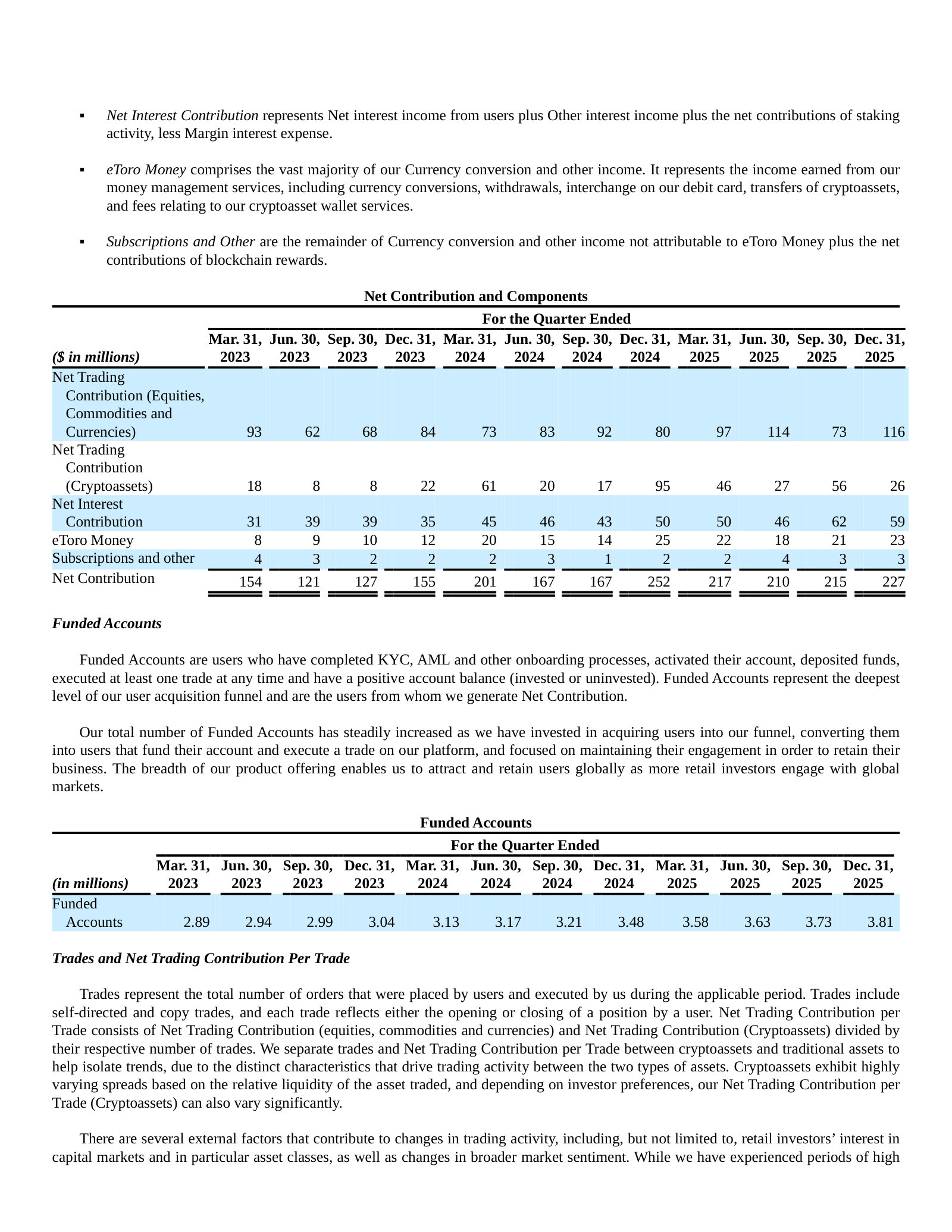
The metric management runs the business on — it strips out the gross crypto revenue and cost that dominate the reported income statement.
Net Contribution = total revenue less cost of crypto revenue and margin interest expense.
Net Contribution reflects Total revenue and income, less the Cost of revenue from cryptoassets and Margin interest expense. We use Net Contribution to evaluate the net contributions of our users’ activity on our platform before considering the overhead costs associated with our operations.
p. 128 · Read in context →
Item 5. Operating and Financial Review — Operating Results — p. 136 · Read the full section →
The income statement's puzzle: $13.0bn crypto revenue against $12.9bn crypto cost, leaving $868m Net Contribution and $216m net income.
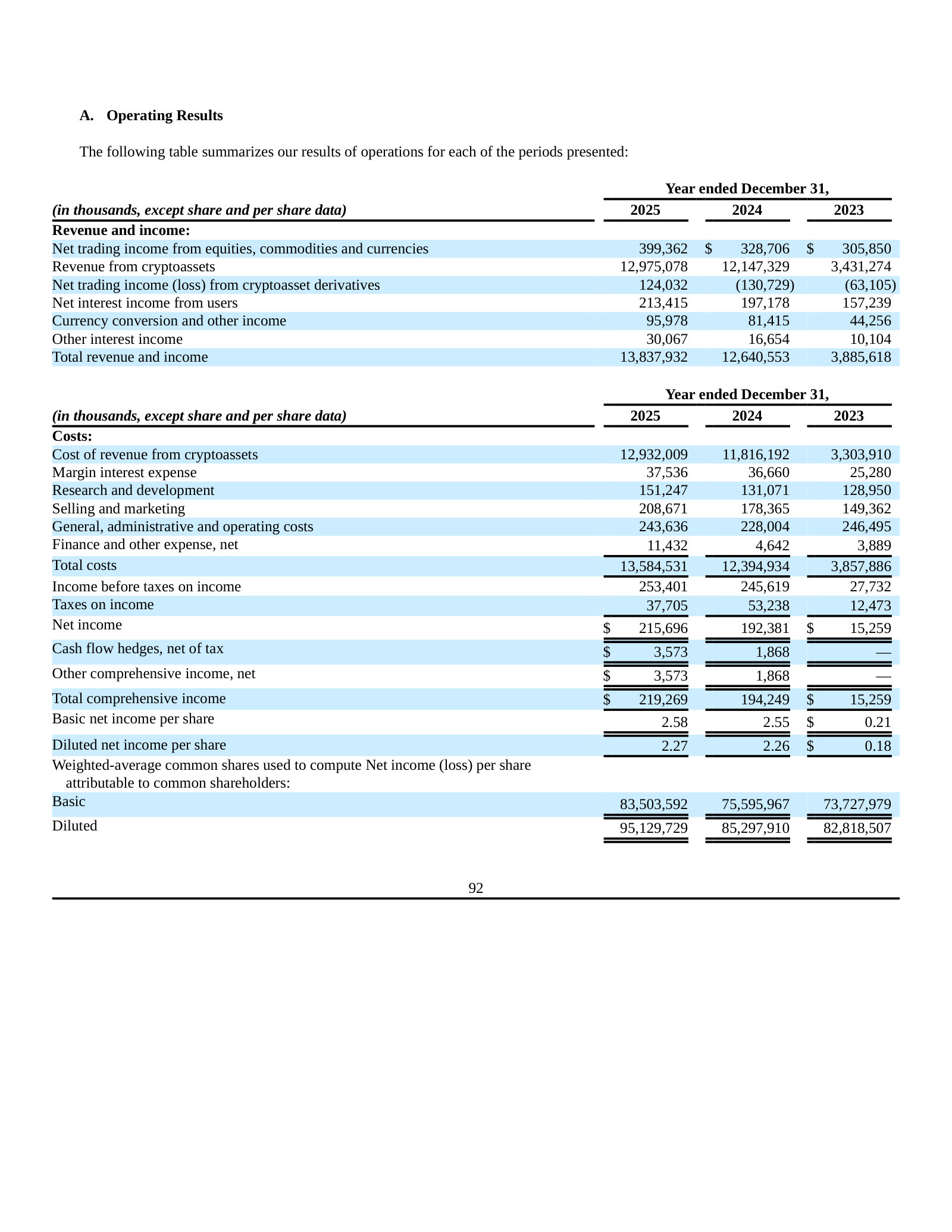
Crypto revenue is booked gross on the sale of cryptoassets to users and counterparties.
When a user trades a cryptoasset as the underlying asset we purchase or sell the underlying asset. When users trade cryptoasset derivatives, we economically hedge our exposure by purchasing or selling the underlying asset. Trading cryptoassets as the underlying asset represents nearly all of our users cryptoasset trading activity. […] We generate Revenue from cryptoassets, which substantially includes revenue generated from the sale of cryptoassets to users and counterparties, and to a lesser extent, revenue generated from staking rewards and blockchain rewards.
p. 137 · Read in context →
Report of Independent Registered Public Accounting Firm — Critical Audit Matter: Cryptoassets — p. 201 · Read the full section →
Defines the custodial model: $4.3bn of users' cryptoassets held off balance sheet, secured by private keys whose loss is the audit risk.
$4,304m of users' cryptoassets held in custody off balance sheet; private-key loss is the critical audit matter.
As more fully described in Note 2 to the consolidated financial statements, as of December 31, 2025, the Company had $62.6 million of cryptoassets presented as current assets, and as described in notes 13 and 18, $4,304 million cryptoassets held on behalf of its users in custody presented off-balance sheet. Cryptoassets are generally accessible only by the possessor of the unique private key relating to the digital wallet in which the cryptoassets are held. Accordingly, private keys must be safeguarded and secured in order to prevent an unauthorized party from accessing them within a digital wallet. The Company holds cryptoassets for its own use, and on behalf of users, in digital wallets and controls the private keys associated with them. The loss, theft, or otherwise compromise of access to the private keys required to access the cryptoassets could adversely affect the Company’s ability to access the cryptoassets within its environment. This could result in loss of cryptoassets.
p. 201 · Read in context →